
Register to POS (Part 1): The Counting Machine that Really Counted
The cash register wasted no time becoming the center of commercial operations, but it had a long way to go.
Retail Counting Is Different
So last week, the SSCS Blog completed a trilogy on the history of counting, because what’s more important to a c-store than that?[1]
Only thing was, we never mentioned counting technology specific to retailers like convenience stores. So let’s remedy that, and look at how the modern point-of-sale (POS) came to be. We’ll start with the mechanical tech from which it grew, which, in turn, ushered in the era of business counting.
Because Business Counting Is Different
As soon as you give counting a business context, counting becomes a little but more than it was. Complexity grows—a lot. It’s not just a matter of a total anymore, it’s how many units sold, how much was made from their sales, and what was left on the shelf.
And then there’s the dimension of time, an incredibly impactful variable that chops up counting into little bits. Finite date ranges (shifts are based on them) allow businesses to measure performance, compare periods, and make decisions based on trends rather than single transactions.[2]
They do, however, require additional skill to monitor and control—a lot for a retailer to handle. Which is probably why it wasn’t a scientist that created the first counting machine for retailers, or a business accountant: it was a retailer, specifically, a saloon keeper.
Ritty’s Incorruptible Cashier
James Ritty was getting tired of his bar losing money for unexplained reasons, and it happened so fast that he couldn’t keep track. In modern terms, his business was under siege from shrink.
After looking at a ship propeller’s counter on a transatlantic voyage, Ritty was inspired to build a machine that made every transaction visible, accountable, and timely—a mission statement for retailers that remains unchanged today.
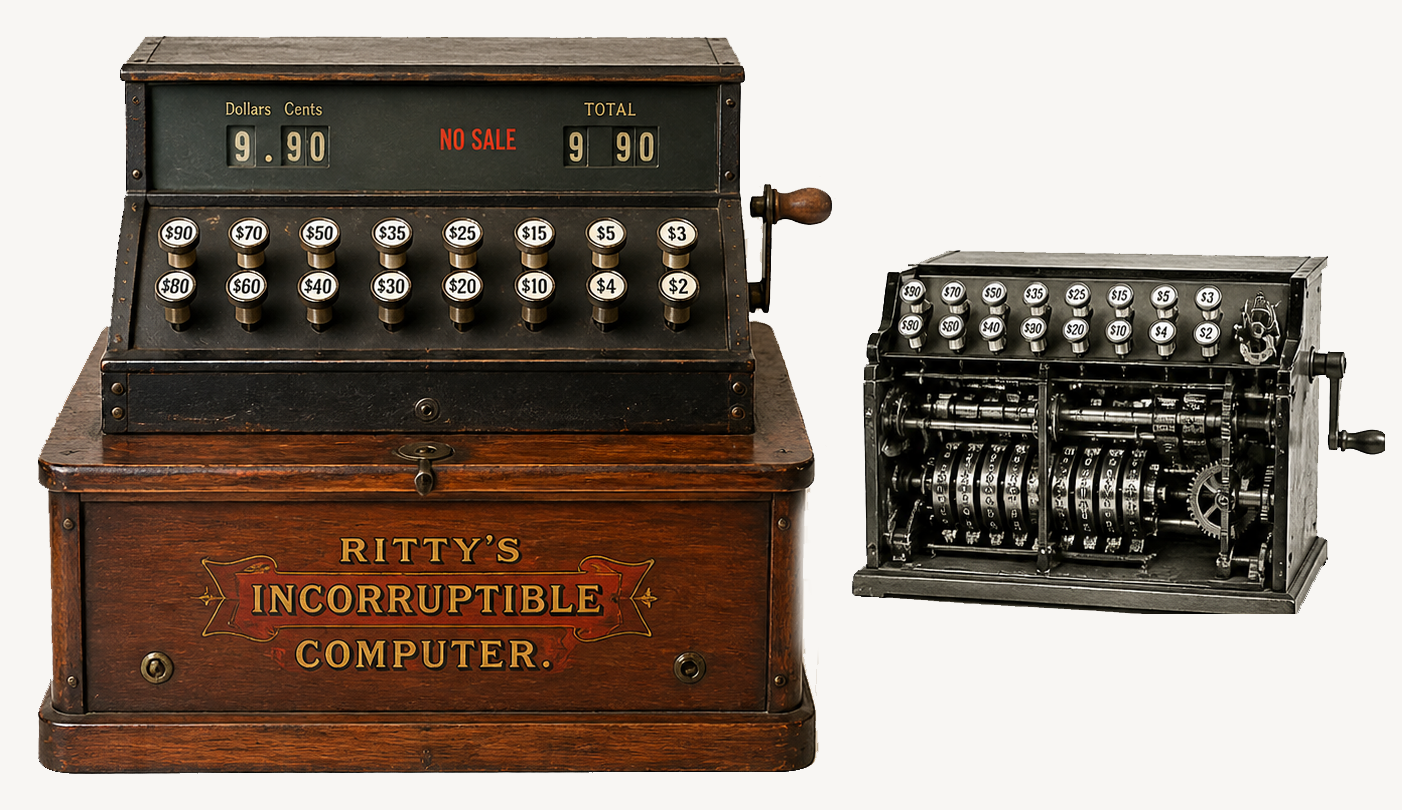
Ritty called his machine, “Ritty’s Incorruptible Cashier[3],” a name reflecting his frustrations with the hired help. The Cashier used keys to display transaction amounts on dials (for retailer and customer), record sales, and lock the cash in a drawer. Sales transactions were recorded in real time, not written after the fact in a ledger. For the first time, the act of selling and the act of counting were tied together in a single moment, though much room for improvement remained.
Registers Grow Up
Ritty received a U.S. patent for his device in 1879 and eventually sold the company to John H. Patterson, who renamed it, the National Cash Register Company (NCR). NCR took Ritty’s invention and industrialized it. Registers became standardized, reliable, and widely adopted. More importantly, they evolved.[4]
Early 20th-century machines added printed receipts, creating a paper trail for both the customer and the store. That simple addition gave owners a way to verify transactions after the fact and an audit trail. A button was added that could total transactions.
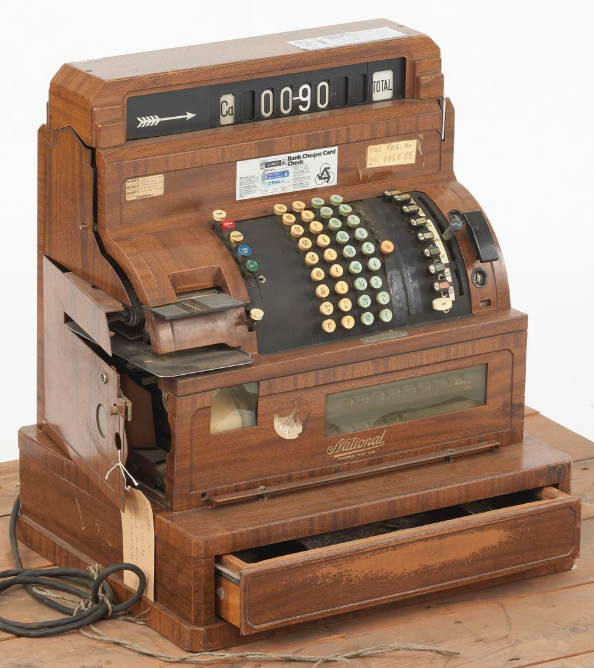
As retail volume grew, so did the pressure on the register, and it improved in almost every way, when it came to counting money, at least. When it came to counting merchandise, though, not so much.
If a retailer wanted to know what was selling, what needed restocking, or where they were losing margin, they were still stuck with manual tracking. The register and the inventory system were two separate worlds. How then to merge them?
By using a tech that is probably older than you think.
When Everything Changed
In 1949, inventors Norman Joseph Woodland and Bernard Silver developed the concept of the barcode. The time was right: besides the expanding business needs of retailers, printing had advanced far enough produce consistent high-contrast marks. And photoelectric sensors and postwar electronics could now turn reflected light into a signal a machine could interpret, like a scanner.[5]
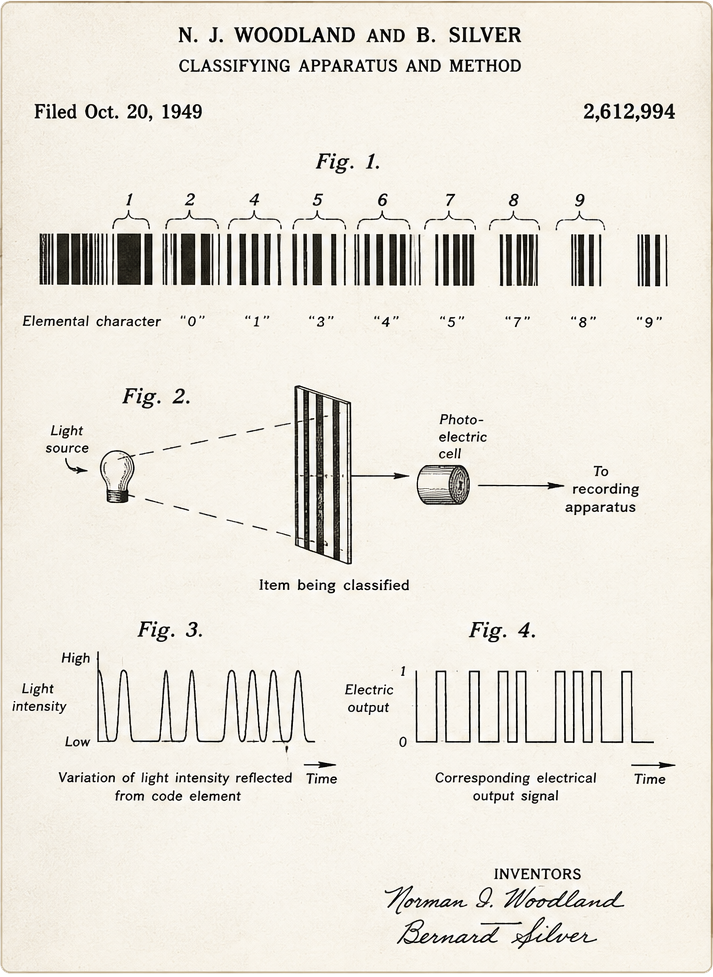
Woodland drew on the logic of Morse code—using bars and spaces instead of dots—to imagine product information encoded as patterns that could be read the scanner. This made it possible to bridge the gap between the register and the shelf, as a scanner that could capture that data automatically meant faster checkout, fewer errors, and—most importantly—a direct link between the sale and the specific item sold. The Cash Register now had the potential to be a point-of-sale powered by electronics.
But a practical version would not be introduced until almost 20 years later. Which is where we pick up in Part 2.
[1] The trilogy starts here, if you want to take a look.
[2] Luca Pacioli. Summa de Arithmetica, Geometria, Proportioni et Proportionalità. Venice, 1494.
[3] He got a U.S. patent for the device in 1879 and eventually sold the company to John H. Patterson, who renamed the company, the National Cash Register Company.
[4] Smithsonian Institution. Cash Register and Accounting Machines. National Museum of American History. https://americanhistory.si.edu/collections
[5] Woodland, Norman J., and Bernard Silver. Classifying Apparatus and Method. U.S. Patent 2,612,994, filed Oct. 20, 1949, issued Oct. 7, 1952.





Leave A Comment