
The Final Countdown (Part 1)
You’ll never think about counting the same way again.
Taking It One Notch at a Time
If you are a c-store operator, your business revolves around counting. Much of the world takes counting for granted, but no one really should: It took thousands of years for civilization to figure out how to do it!
Counting probably started out of necessity, something like figuring out how many animals were in the herd or keeping track of how much grain was left in the storage pit. Or maybe Stone Age people found it useful to count days before a seasonal change, either for agriculture or migration.
Here’s the thing, though: counting started before numbers even existed.[1] Early human beings used physical matching called “one-to-one correspondence”. An example would be representing one sheep for each stone for or marking each passing day with a notch on a stick.[2]
A New Way to Count: Fingers and Toes
Physical matching is as literal as it gets when it comes to counting, so it didn’t take long for its limitations to become apparent, like how are you going to find 1,000 rocks to represent 1,000 goats? Merchants needed something less representational, so they used fingers and toes; that’s why so many counting systems are based on increments of 10.
It wasn’t the only system of counting that came from using one’s hands, though, just think inches/feet, months/year, dozen/eggs, signs/zodiac, etc. The 12-based system started in Mesopotamia where they used the thumb to count the three segments on the remaining four fingers (3 x 4 = 12).
The Ishango Bone and Other Early Tools
The first tool that helped extend the concept of counting beyond what you could see and touch was discovered around 20,000 BCE.
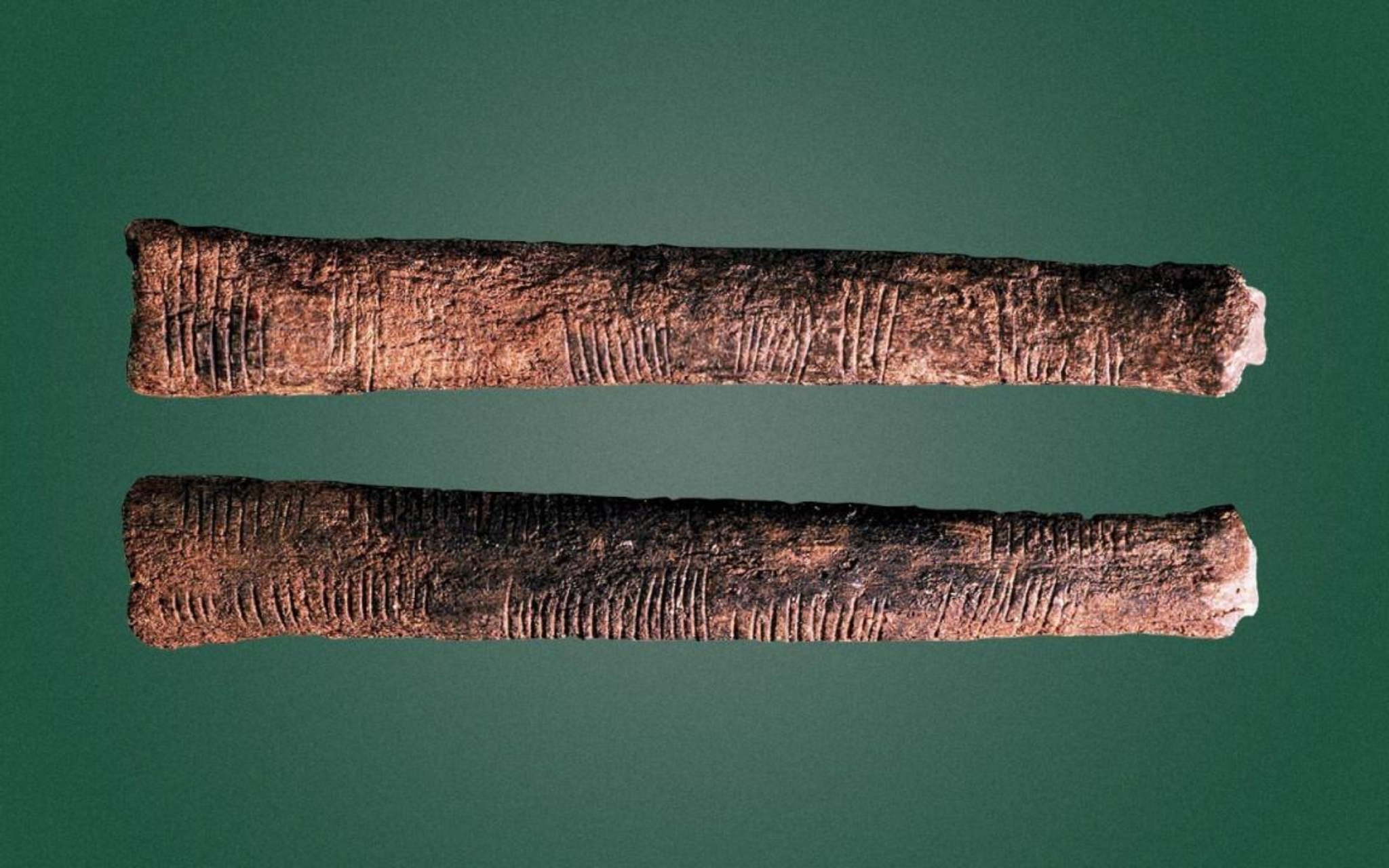
The Ishango Bone, a prehistoric tally stick. Photograph courtesy of the Royal Belgian Institute of Natural Sciences.
It’s called the Ishango Bone, and it was found in central Africa in the 1950’s. It’s a notched baboon fibula, but its notches are grouped in very specific ways, perhaps related to numbers, lunar cycles, or some type of trade. Some bones have a shard of quartz fixed to one end like a wand. This suggests use for engraving or marking calculations in soft dirt.[3]
Other expanded ways to count began to crop up at the same time. Sumerians used clay tokens and marks for accounting. Egyptians used Hieroglyphics to represent numbers for administration, taxes, and construction. By 1200 BCE, the Chinese were using counting rods for astronomy as well as trade.
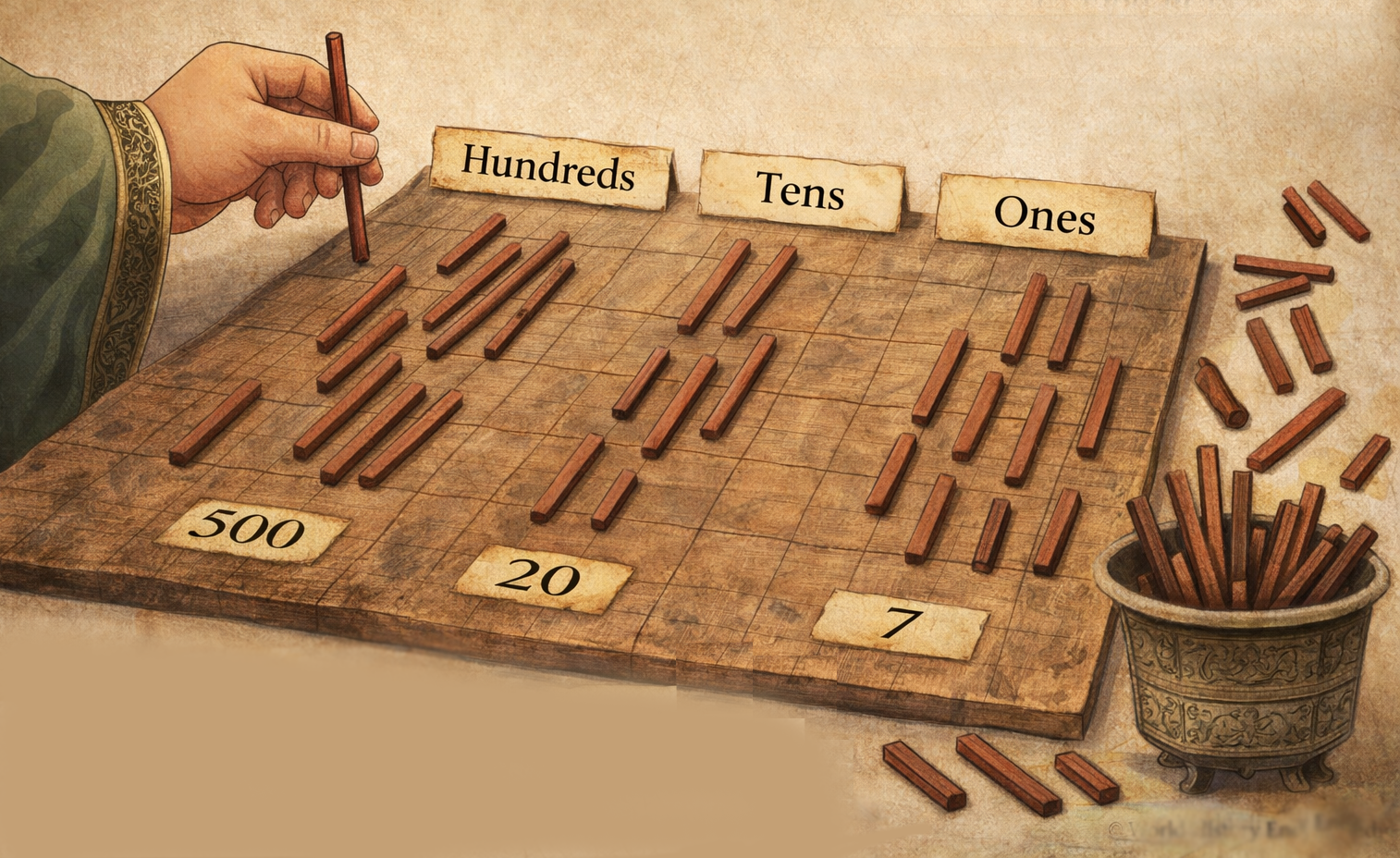
Typical 12th Century Counting Rods. Photograph courtesy of the World History Encyclopedia.
Math Begins
But the first huge breakthrough in counting was arithmetic[4], a way to count without being able to see and touch stuff. Being able to use symbols (like numbers) to help do the mental gymnastics needed for complex counts—a.k.a. “calculations” —was a quantum leap for not just counting, but humanity as a species. It was like a different way of thinking.
Additional symbols were developed to manipulate the numbers further: adding, subtracting, multiplying and dividing. These calculations were written down, such as on a cuneiform tablet, so they could be taught to others. With the reliance on what you could see and touch no longer necessary, projecting numbers became possible for the first time in history.
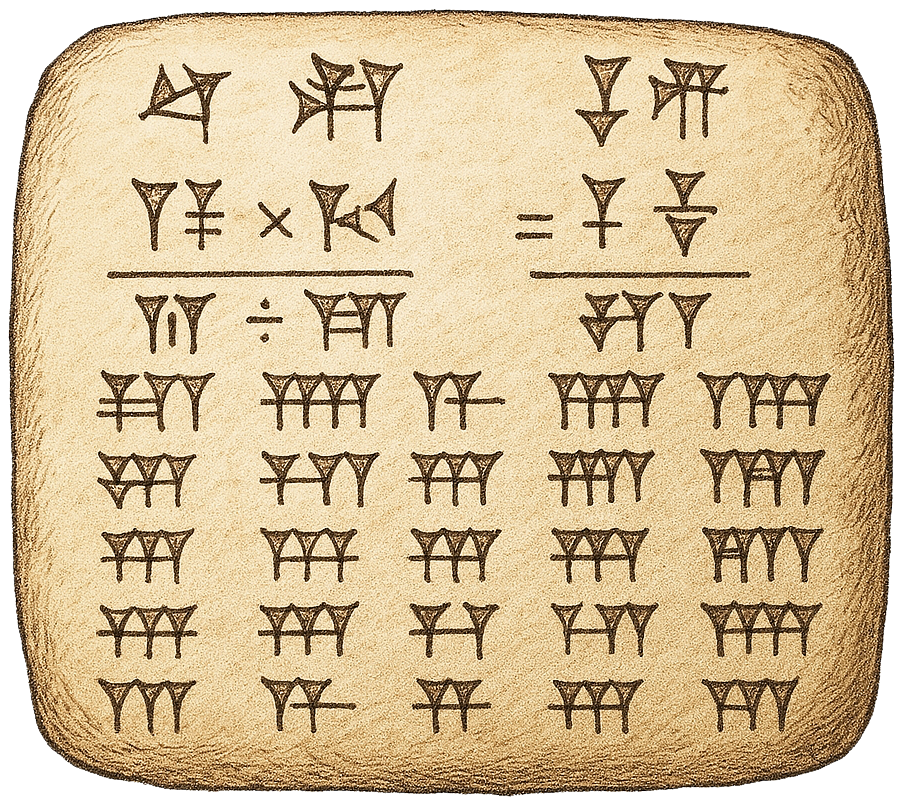
Early cuneiform arithmetic. Image courtesy of Science Awakening I: The Birth of Astronomy, van der Waerden, 1954.
The earliest arithmetic developed in Mesopotamia, with parallel advances in ancient Egypt around 600 A.D. These civilizations sat at the middle of the world at the time, on fortuitous trade routes, and the growing number of merchants and businesspeople found themselves facing an explosion of demands for managing goods, labor, and taxation. Arithmetic is one of the first examples of commerce driving innovation, something every successful c-store operator is familiar with, even thousands of years later.
Even so, there is a human limit to the scope and speed even the brightest minds can process the numbers, and it was only a matter of the time until the world started building machines, mechanical first, and later electronic, to help them count.
We’ll talk about it next week.
[1] Number Words and Number Symbols (Cambridge, MA: MIT Press, 1969).
[2] The History of Mathematics: An Introduction (New York: McGraw-Hill, 2011).
[3] The Ishango Bone, (Belgian Museum of Natural History, https://www.naturalsciences.be/en/), no date.
[4] Arithmetic is just one form of what we call “Mathematics”. Algebra, Geometry, Calculus, and Statistics are the others.





Leave A Comment