
Register to POS (Part 3): It’s Not a POS, It’s a System
Today’s POS can’t help but be defined by the technology to which it connects.
This is the final post in a three-part series. Find Part 1 here; Part 2 here.
Stripes Become Fashionable
We left off last time with retailers staring into the beam of a laser, and wondering whether the future arrived.
It hadn’t. At least not yet.
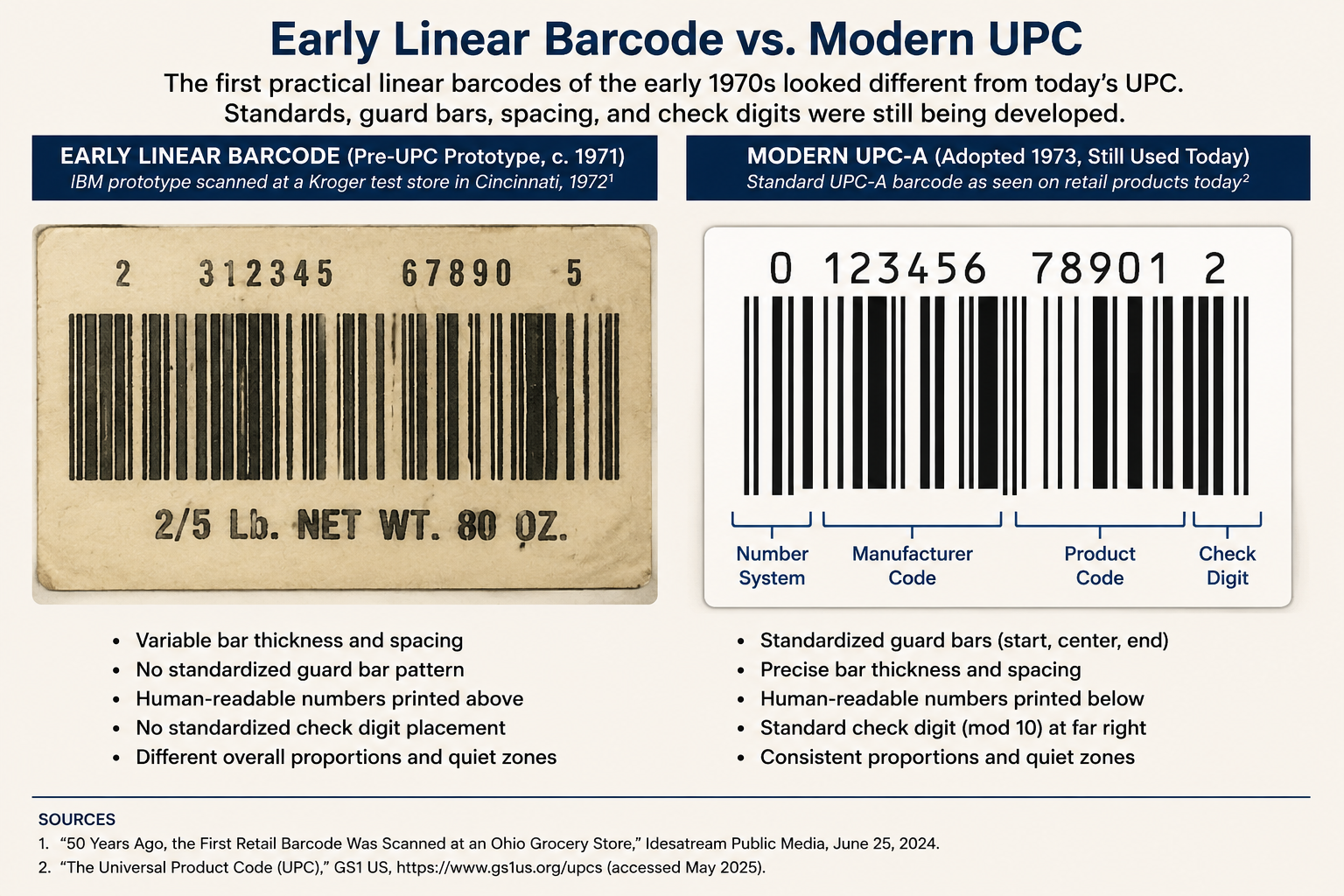
Progress couldn’t really start until researchers ditched the difficult-to-print-clearly circular barcode[1] and went with the (essentially) same striped model from which today’s UPC, that kernel of electronic item information is derived. Once stripes became the fashion, the industry never looked back.
A Convergence of Trends
Still, an individually scanned barcode remained far from what was the industry needed. Other key trends, united by mutual interest, had to converge for that to happen.
The most significant development, especially in the beginning, was the enormous government and corporate investment poured into electronics, computing, laser, and automation research[2]. This reduced the size and cost of the necessary tech.
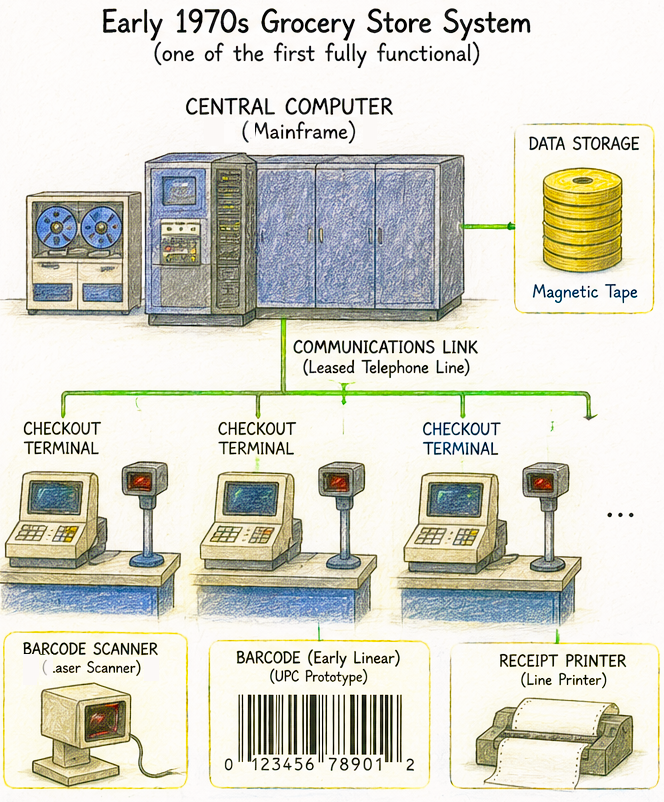
The rise of reliable of networks through electronic data, powered in large part by banks and airline companies, was another key. Info encoded in a barcode—like merchandise sales information!— could now move from networked machine to networked machine[3]. Suddenly it became easy to envision multiple lanes communicating with a central business computer at the grocery store. It helped that computers for ringing up sales could now fit in or around a checkout counter.
Still, this existing “potential” hadn’t done much for your average grocer in the late 60s and early 70s. Part of it was how long it took for retailers to even hear what scientists were devising.
That’s because in those days, marketing was way different than it is today. Technological advances usually spread through patents, trade journals, and university connections. But that was about to change: this time retail grocers would get actively involved in shaping the technology designed for their benefit.
An Industry in Crisis
Grocery trade associations had been growing and becoming more active as the 1960s switched over to the 1970s, motivated in no small part by an operational crisis of historic proportions. Everything was getting bigger: store size, number of discrete SKUs, checkout lines, labor costs among the most impactful.
These developments got grocery trade organizations across the U.S. extremely motivated to help find a solution: they felt their future was at stake. After that, it was a matter of time before association members were working with representatives from the biggest technology companies, who were just as anxious to procure a viable market for their technology. The climax of these efforts was the Ad Hoc Committee on a Uniform Grocery Product Code in which retailers, manufacturers, and technology providers all participated.
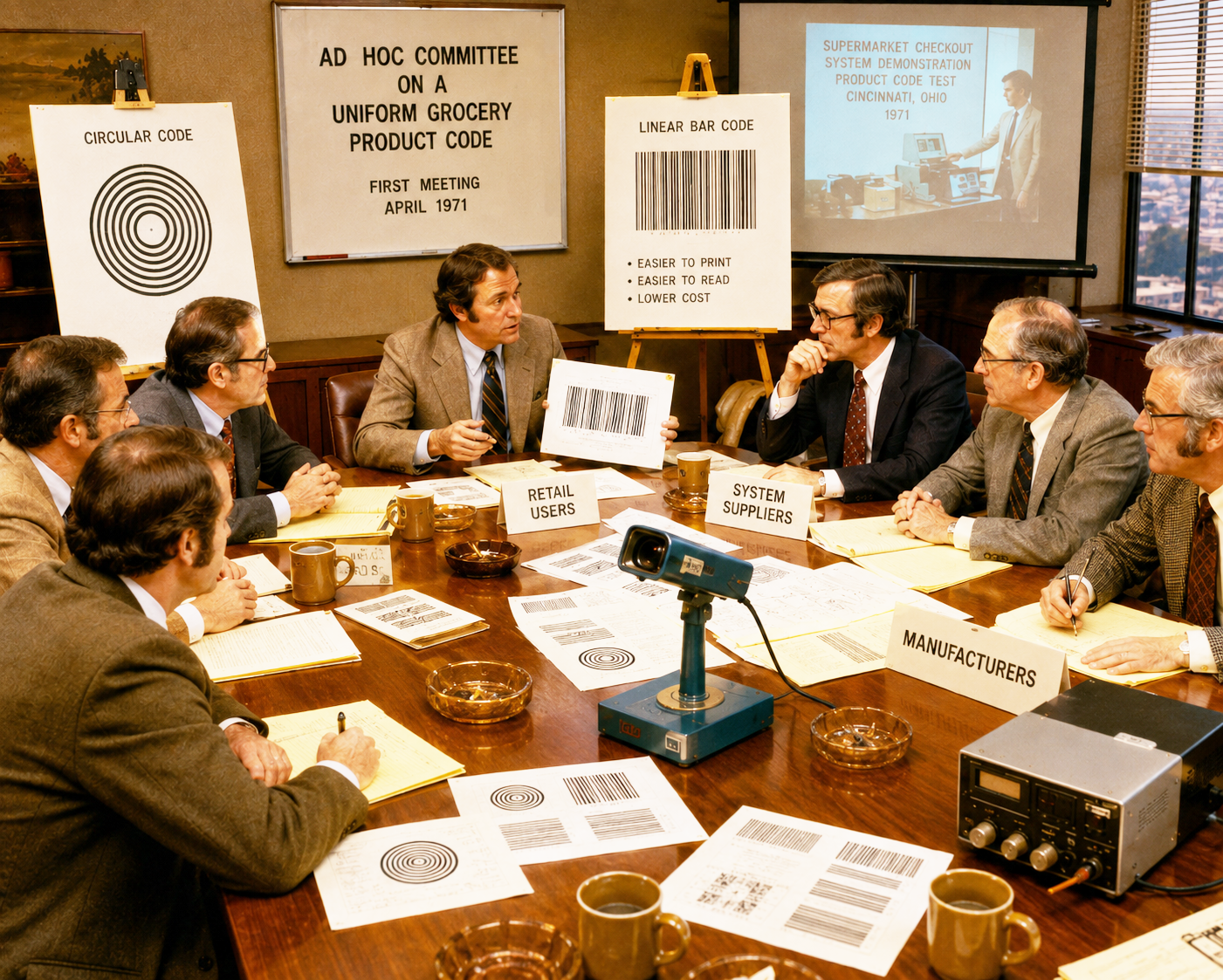
This became the birthplace of the UPC standard the industry uses today, since networked data is of little use if the machines connected to it can’t share and read it.
From Machine to System
Working with retailers and other committee members, major technology companies began to build public prototypes, getting scanning out of the lab and into the real world. Many an early POS, even the electronic ones, still looked like oversized cash registers—some even hummed electronically—but the fundamental change had taken place. The POS was no longer a standalone proposition; it was part of a system, and it would be that way forever.
In the decades since, while the fundamental store functions that are supported by technology haven’t changed much, the technology, itself, sure has. In addition to the continuing trends of miniaturization and price normalization, a half century of other improvements have come to redefine the POS and the store system to which it is connected.
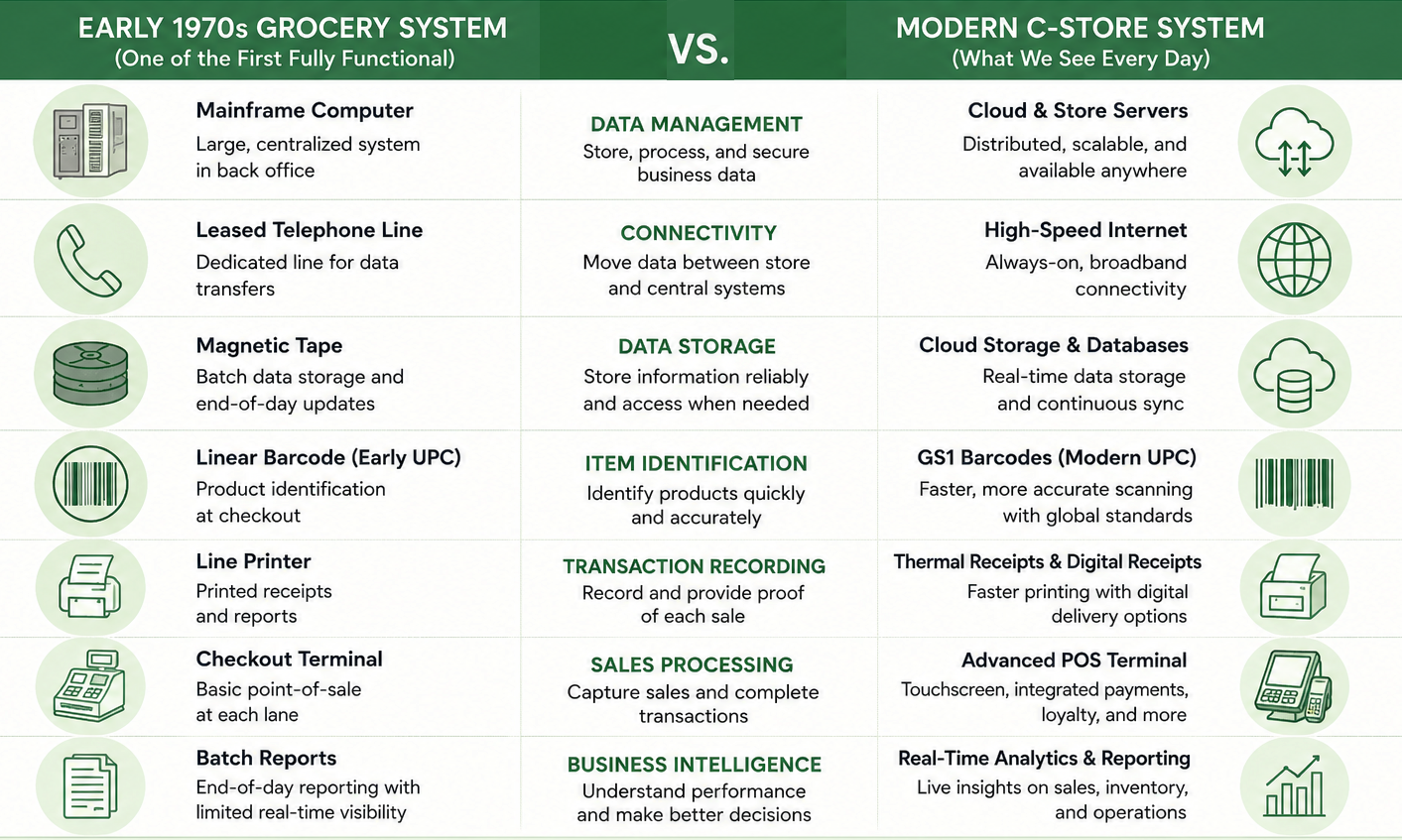
Every one of these improvements is win for c-store operators and retail grocery in general, including the maturation of inventory management, which became less delayed, less manual, and less error-prone.
What It Means for You
Of course, to gain the full benefit of today’s integrated points-of-sale and the c-store technology to which it integrates, you need to know your system’s capabilities from end to end, and you need to know how those capabilities are designed to improve any aspect of your c-store.
SSCS has vast experience helping customers do both of these things—since 1981, as a matter of fact. In that time, we have accumulated experience with a wide variety of POS’s, including knowledge of what it takes to optimally integrate them with our Computerized Daily Book (CDB) back office, scanning solutions, and pricing controls.
That’s not the end of it. A complete SSCS software system is going to uncover other ways to you can shore up your margins and run more efficiently. The POS has evolved into a formidable tool, but it’s just a start. Call us a call at (800) 972-7727 for a look into the full scope of what you may be missing.
[1] See Part 2.
[2] David C. Brock, “The History of the Bar Code,” Smithsonian Magazine, National Museum of American History, accessed May 2026.
[3] Ibid.





Leave A Comment