
Increasing Payment Scope While Reducing Lag Time
Credit isn’t about stern accountants scribbling into lined ledgers anymore.
Credit for payment was born out of personal relationships. You ran up a tab with a friendly local merchant. Or you wrote a check, a variation on the classic IOU. These methods were joined in the early 20th Century by store charge plates[1], followed by the real gamechanger, the Diners Club card in 1950—a single card of credit usable at multiple, unrelated businesses for which billing later could be settled. Diners Club operated as a centralized charge-card company: it controlled the relationship between cardholders and merchants, profiting from both sides.
That prepped the market for the next credit development: the one-two punch of Visa (BankAmericard —1959) and MasterCard (MasterCharge—1966), which extended credit on behalf of merchants from a loose association of participating banks. They issued uniform cards laying the groundwork for the nationwide credit card networks,[2] brought to fruition by the magnetic strip which allowed a card access to them.
Now that these cards could communicate payment/credit information electronically, the stage was set for the earliest connected points-of-sale (POS). Unmatched speed and accuracy impressed retailers out of the box. They wasted no time influencing further improvements in the payment process, case in point: debit cards that eliminated the need for personal credit altogether, as customers paid directly from their bank accounts.
Today, computers and communications networks positively impact payment processing in more and different ways:
- ATMs make cash accessible without visiting a teller.
- EFT and ACH systems move money between financial institutions—no check required.
- With the rise of 1990s online ordering, online transactions and chip-equipped EMV improved security.[3]
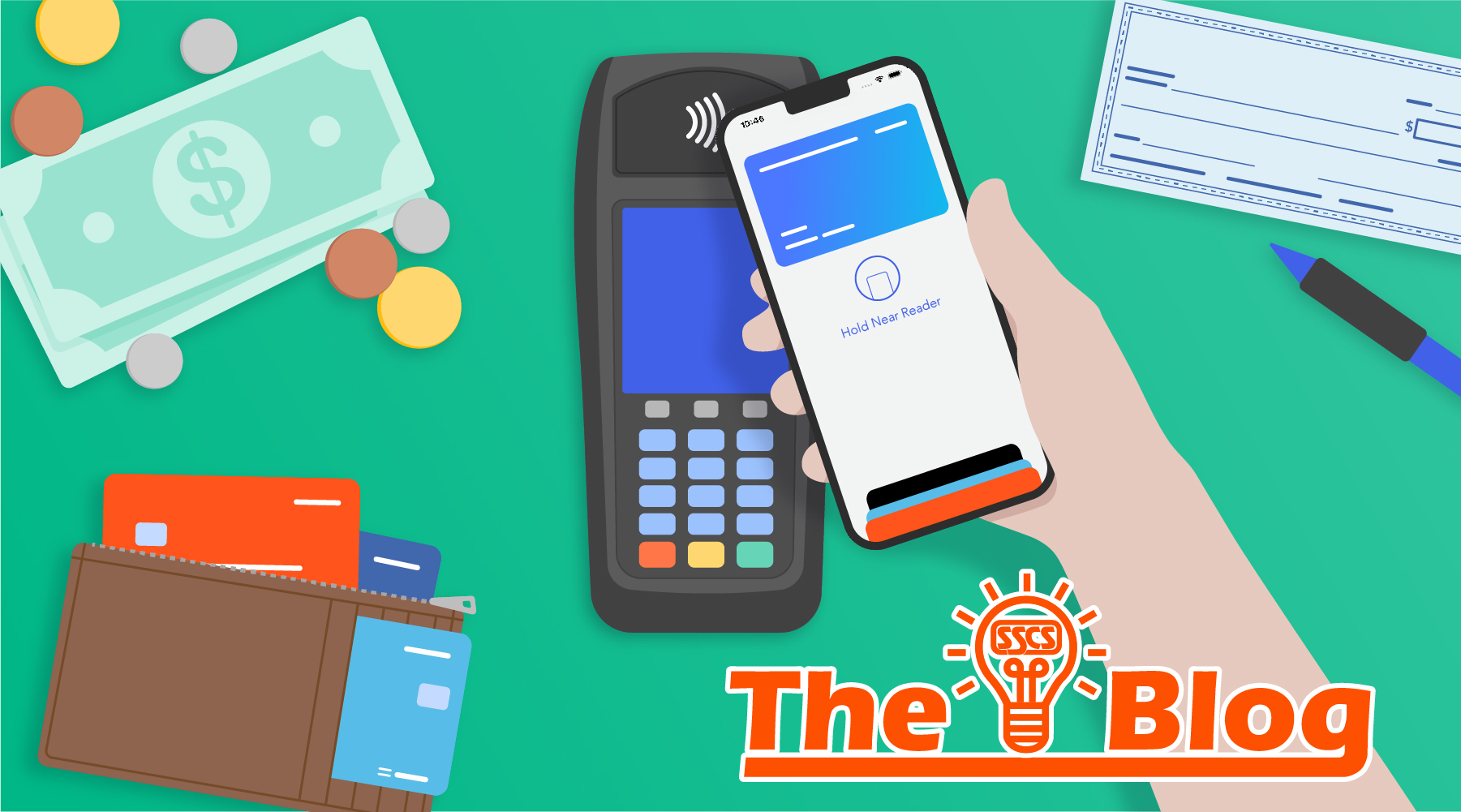
- Today contactless cards and smartphone wallets like Apple Pay and Google Wallet bring near-instant transactions to the checkout counter. You can even tap a card, phone, or watch for payment, and reach the same interconnected system operating behind the scenes.
Convenience retailers can’t forget, however, that the transaction is just part of the picture. Every payment has to be accounted for, reconciled, and connected to the rest of the business. That’s where SSCS’s Computerized Daily Book (CDB) comes in. Our back office software captures all that payment information coming into the store, and presents it in an organized way so you can start earning additional profit ASAP. Unlike payment processing, though, our technology comes with a distinctively personal touch. Give us a call at (800) 972-7727 and see.
[1] Small metal or plastic identification plates issued by department stores to regular customers embossed with the customer’s name and account number and presented at checkout so purchases could be charged to an in-store account.
[2] Although at the time mostly using paper slips, manual card imprinters, and telephone authorization for larger purchases.
[3] By the 2010s, inserting a chip had largely replaced swiping in the U.S.



Leave A Comment