
The Need for Speed
Today’s customer expects short, seamless retail experiences. There’s reasons for that.
Life moves pretty fast. If you don’t stop and look around once in a while, you could miss it.”
— Ferris Bueller
The fast pace of life. It’s a cliché, but only because it’s true.
Except it’s been a cliché for more than half a century, when it first came to prominence as an idea in the 1960s. That’s when writers and researchers were starting to use phrases like “the accelerating pace of modern life” and “the tempo of social change.” And then the concept all came together in 1970 in a huge best-selling book called Future Shock, the viral sensation of its time.
But here’s the thing. People kept saying “things are moving faster than before” every year after that. If that’s the case, how fast must we be moving now?
For some consumers, the answer is “maybe not enough,” as the demand for shorter shopping experiences continues to rise.[1] How did the consumer get into a seemingly chronic state of wanting more, better, faster? Here are some of the key events that have conditioned them, over time, to feel this way:
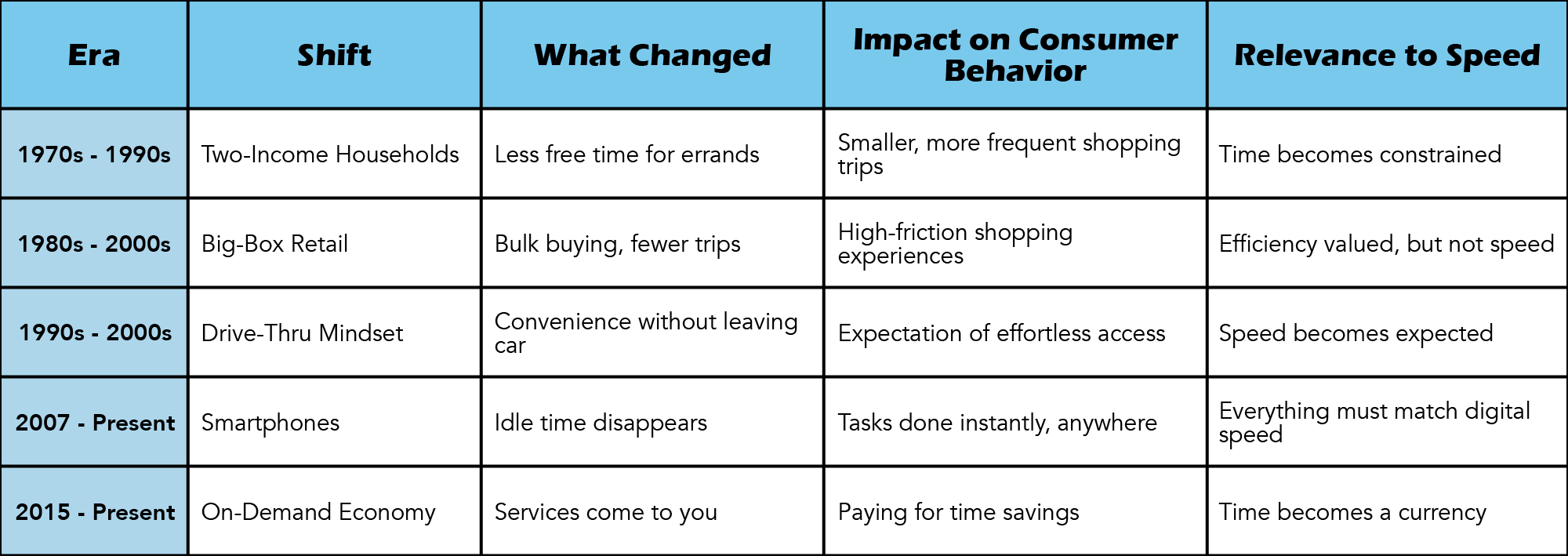
- The two-income household becomes a fixture (1970s–1990s). Dual-income households changed the concept of adult time. Having two workers instead of one removed a big chunk of available household time for errands, meal prep, and multi-stop shopping. The loss of daily “slack” time, is where the consumer starts feeling squeezed for time.
- Big-box retail begins to dominate. (1980s–2000s). Big-box retailers conditioned consumers to think in terms of efficiency per trip—stocking up, buying in bulk, and minimizing frequency. But each trip took more planning and required more time, which opened an opportunity for c-stores to differentiate themselves by competing on speed instead of scale, proving there was a place for both approaches.[2]
- Emergence of the drive-through mindset (1990s–2000s). Quick serve restaurants, for the most part, premiered their own proof of concept for fast, relatively effortless retail by removing the need to get out of a vehicle. This capability further compressed time expectations for a retail transaction. About this time, consumers are starting to discover they can realize similar speed improvements at c-stores, with or without drive through.[3]
- The rise of the Smartphone (2007–present). If the two income family halved household open time (#1 above), personal handheld technology vaporized it—it has become possible to be engaged in something, anything at all times. Instantaneous access to information on a phone only sped up consumer expectations for just about everything else in life, including shopping.
- The On-Demand Economy (2015– Present). With the availability of free time continuing to shrink, consumers have little choice but to fit more errands and activities into what they have. Third-party delivery services have flourished in this climate, as they can be delegated to handle shopping, freeing up the customer for other simultaneous tasks. It’s also a clear example that people are willing to pay for time savings, through delivery fees and such.
As the pressure for fast, frictionless experiences builds, the convenience store industry remains positioned well, as might be expected from an industry that has “fast and convenient” baked into its DNA.
But speed and efficiency is only feasible if you have the right technology running your enterprise. We’re talking software that delivers quick access to key metrics like inventory, sales, and margins, with not only current analysis, but projected performance. After all, the future is coming faster than ever.
SSCS has been around for over 45 years, and along the way we’ve acclimated ourselves to the increasing velocity of the retail environment and the demands that it makes on c-store operators. Our software solutions evolve as the industry evolves, which we would be happy to demonstrate should you give us a call at (800) 972-7727.
[1] “Speed, convenience rank tops with shoppers”; no author listed; customerretail.com; October 24, 2023
[2] The Wal-Mart Effect; book; Charles Fishman, December 26, 2006
[3] “Factors Influencing Repurchase Intention in Drive-Through Fast Food: A Structural Equation Modeling Approach”; abstract; various authors; Betina Piqueras-Fiszman (Ed.); National Library of Medicine (NLM); May 27, 2021


Leave A Comment