

More Posts about Buildings and Food Trucks
The food truck was basically invented in 1866; it looked a little different then.
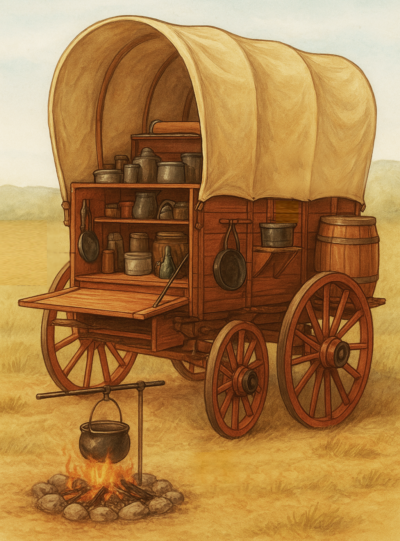 The first food truck was a chuck wagon. We even More know who invented it, an entrepreneurial rancher named Charles Goodnight.
In 1866, Goodnight repurposed a U.S. Army surplus wagon (a Studebaker!). He modified it by adding a rear “chuck box” with drawers; a fold-down worktable for meal prep; mounted water barrels; hooks and racks for pots, skillets, and Dutch ovens; and storage compartments for food and dry goods.
It was far from the only milestone on the path to the food truck we know today.
In the late 1800s, cities introduced lunch wagons—nighttime food carts that offered inexpensive meals to workers and inspired the first diners. In the early 20th century, pushcarts selling ice cream, tacos, pretzels, and sandwiches became popular in dense urban neighborhoods, embedding mobile food into everyday life.
After World War II, industrial catering trucks brought food to factories and construction sites, in unglamorous but utilitarian affairs, with a silver panel foldup on one side.
They’re still around.
But it wasn’t until the 2000’s that the Internet and social media helped turn food trucks into a global phenomenon, not only for their food, but for their often colorfully designed rigs designed to capture attention.
The market kicked it up a notch in 2008, when the gourmet food truck officially became a thing. L.A. celebrity chef Roy Choi launched Kogi BBQ in Los Angeles. It marked the beginning of an upscale movement that continues[1], accelerated by instant universal access to videos and images which encourage the mixing and matching of regional cooking styles. As a result, fusion cuisine has become pretty strongly associated with the retail food truck channel. The current market continues to show strength, too, as industry revenue continues to grow at a 13.2% annualized rate.[2]

As c-store owners look for ways to expand their market, a few operators have started to explore partnerships with food trucks, as a kind of extension of their Foodservice component.[3] The benefits of such agreements haven’t been lost on the food truck industry, as publications openly promote the advantages for partnering with a “gas station.”
Though for the great majority of operators food trucks aren’t a viable option—the space they require prohibits wide adoption—at least one regional chain, Q-Mart, is openly soliciting food trucks with which sites can partner. And it’s always interesting to look at the models that do work, like these two:
Dave’s Station in McMinnville, Oregon has evolved and still operates out of the 1950’s gas station it started as, but it has significantly expanded its real estate over the years. There’s now room for six (!) food cart spots, with hookups and indoor/outdoor covered seating. The local vendors are taking Dave up on it: five of the stalls are currently occupied. Patrons can choose from Mexican, Indian, Philly Cheesesteaks, Thai, and Fried Chicken. There’s a full bar inside the gas station, too.
The Brew Pump (CitiStop), Asheville, North Carolina. This CitiStop location has been described as a “gas station meets brew pub meets food-truck park.” It’s almost like a rustic mini-mall anchored by a c-store with a gas stations that still provides automotive service. Their huge lot hosts rotating food trucks in an atmosphere the owner describes as a “backyard just like yours” with chairs and picnic tables and rousing games of cornhole. The Brew Pump inside the gas station gets a lion’s share of the attention, but there’s a lot else going on at this c-store complex.
You don’t need to have a food truck to be a successful c-store operator, but you are going to need technology. It’ll help get you through whatever market changes may come your way by providing the constant of improved efficiency and profitability. You don’t have to take our word for it, though. Give SSCS a call at (800) 972-7727 and let one of our seasoned sales reps show you how technology helps provide the stability you need to get through whatever may come your way.
[1] “How America became a Food Truck Nation”; Jonathan Gold; Smithsonian Magazine; March 2012
[2] “Food Trucks in the U.S. – Market Research Report”; Valerie Le; IBISWorld; July 2025
[3] “Recipe for Success: Local Food Truck Partnerships”; no author listed; www.gilbarco.com; February 21, 2020





Leave A Comment